|

Impedance is the combined effect of capacitance, inductance, and
resistance on a signal. According to Ohm's law, voltage is the
product of current and resistance at a given frequency.
Impedance is the measure of resistance to electrical current
flow when a voltage is moved across it. Impedance is measured in
ohms and is the ratio of voltage to the flow of current. For a
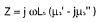
series circuit, the Reactance is
and Resistance is Rs then the impedance,
The impedance can also be expressed in terms of complex
permeability as
In low frequencies, the inductance is prominent and at higher
frequencies, the resistance. To have a high Q component, the
resistance part must be low and inductive part must be high. At
higher frequencies, these inductors act not as inductors but as
resistors, dissipating the noise into heat and performs as a
noise suppressor. Hence, in the selection of ferrites for EMI
suppression, the impedance in the selected noise band is
important.
Thus the impedance can be translated in to magnetic
characteristics separating out the real and imaginary part.
Another expression for impedance is
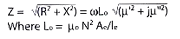 |
One advantage of this equation is that the impedance is
proportional to the square of the number of winding (N) for a
same product.

Resistivity of Ferrites depends on its chemistry. NiZn ferrites
have a resistivity of more than 1 MW-m and MnZn ferrites is in
the range of 1 to100W_-m. Due to the higher resistivity of NiZn
ferrites, eddy current losses are at minimum making it useful
for higher frequency applications. The DC resistivities are
measured at room temperature (25°C). The resistivity reduces at
higher frequencies as the grain boundaries get short-circuited
due to electron hoping.

For a non-uniform core, a hypothetical torroid equivalent can be
calculated using:-
And effective parameters are calculated from C1 & C2
Ae of ferrite is inversely proportional to saturation current
and directly proportional to attenuation.
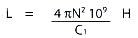
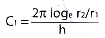
C1 is also used to
calculate inductance of a core configuration through
For a toroid,
Where r1
= internal radius of toroid
r2
= external radius of toroid
h = height of toroid

Performance of ferrites as EMI filters under DC bias conditions
are considered as one of the significant parameters of ferrite
quality. Very large lossy impedance is achieved in ferrites when
it is operated under bias condition creating less than the
saturating magnetic field. Once saturated, the permeability
becomes one (equal to that of vacuum) and this condition is not
good for any ferrite applications.The bias field reduces the
impedance of ferrites and best impedance is achieved in zero DC
bias conditions. Technically the bias conditions are important
because there are many EMI suppression applications under the DC
field. Hence, ferrites with higher saturation magnetization (B5)
is required to suit extreme bias conditions. ACME manufactures
high B, NiZn ferrite materials for this purpose. Increase in the
mass of ferrite components can also compensate this requirement.

Permeability increases with temperature to a maximum and drops
suddenly after a certain temperature.This temperature is defined
as Curie Temperature (Tc). Ferrites becomes paramagnetic after
this temperature due to the complete disordering of magnetic
moments caused by thermal energy.
Ic is normally controlled by the chemistry of ferrites. Thus
each grade has its own Tc value and the higher the initial
permeability, the lower the Ic value.
Saturation flux density also decreases with temperature. This is
again due to the thermal disordering of magnetic moments in
ferrites.AtTc,the flux density reaches zero.
The change in permeability with temperature is quantitatively
expressed as Temperature coefficient of permeability (IC).
Temperature factor of permeability is given by:
 |

It is the frequency at which the distributed capacitance
resonates with inductance. The inductor will act purely as a
resist at this condition and provide maximum impedance.

Insertion Loss is expressed as:
Insertion loss is important when ferrites are used as EMI
suppressors. In the RF range, ferrites shows very high impedance
and due to this property, ferrites suppresses the RF passing
through it converting it to heat.
E0 is the voltage without ferrite and E is the voltage with
ferrite inductor. |