|

This represents the time stability of permeability. The decrease
in Permeability is approximately proportional to the log (Time).

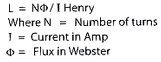
Inductance is the ability of an inductor to induce emf when
there is a change in current, It is also the flux linkage to
unit current. The unit of inductance in Henry.
Inductance is the property of a conductor or a circuit, which
resists the change in current. Hence, it causes current changes
to drag behind voltage changes. An inductor stores the energy in
the form magnetic field. Inductance is proportional to the square
of number of turns and the proportionally constant is called
inductance factor ( AL) ie,

Magnetic loss is expressed as loss tangent (tan
d) and the
contribution comes from inductive (reactive,
wLs ) and
resistive, Rs. tan
d is the loss angle i.e., the angle between
the Flux (B) and Applied field (H).
The loss angle is also directly related to the real (m') and imagenary (m") part of permeability, as represented by:
Loss factor is defined as the ratio of loss angle to initial
permeability. Which is inverse to the Q- factor.

Quality factor is the inverse of loss factor, tan
d /
mi. NiZn
ferrites are capable of giving a higher Q factor at higher
resistivity compared to MnZn ferrites. Q is sensitive to not
only the chemical composition but the post sintered handling
also. Proximity to strong magnetic field or mechanical stress
can reduce the Q value of ferrites.

In a series inductive circuit, the reactive and resistive
components are related to complex permeability by:
Where m" is the imaginary component and
m.' is the real
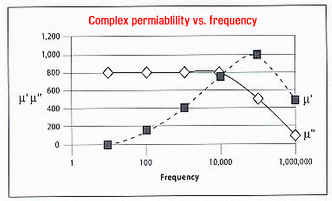
component. The graph below shows the behaviour of initial
permeability (real and imaginery) at different frequencies.
|