|
Some of the important features of
NiZn ferrites are described here in order to give a glimpse of
the magnetic properties to our valued customer.

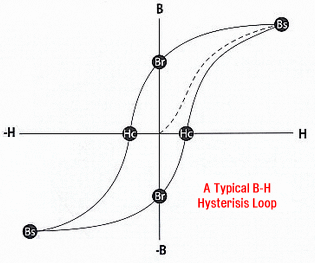
A non-magnetized Ferrite when subjected to an AC magnetic field
creates a loop as shown below. At very low fields, the BH
relation is reversible and on higher fields the relation becomes
non-linear and non-reversible. Saturation magnetization (Bs)
represents the saturation limit of flux density and Remanence
(Br) is the residual flux even after the withdrawal of the
inducing field. Coercivity (Hc) is the magnetic field required
in the opposite direction to demagnetize the ferrite.
The internal resistance imposed by anisotropy and other pinning
centers causes the delay in magnetization. The energy consumed
to overcome this resistance is indicated by the area of the BH
loop and is called hysterisis loss. Ferrite cores are
manufactured as per customer requirements and a wide range of
products are available with different sizes and shapes. Correct
materials are selected to make the finished ferrite suit all the
customer requirements. These materials are tested on a standard
toroid and used as a guideline to manufacture the right
components.

The most significant property of ferrites, which determines its
performance, is the permeability and its response to external
factors like Temperature, Frequency and Bias field. Permeability
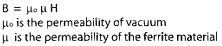
is the ratio of magnetic flux density (B) to the magnetic field
causing the flux generation (H). In simple
terms the 'B' is related to 'H' by B =
m◦
H where m◦
is the permeability of vacuum, 4p
x 10-7 H/m.
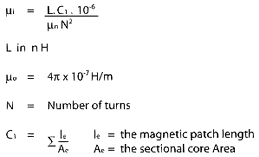
Initial permeability of ferrite material is defined by Initial
permeability of ferrite material is defined by
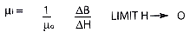 |
Initial permeability is measured on toroidal cores at very low
applied fields. The flux density generated may be less than 0.1
mT. Initial permeability is calculated from the measured value
of inductance (L) and calculated value of core factor Ci using
the formula

Ferrites when subjected to a magnetizing field induces magnetic
flux (f,
Webster) and the flux per unit area is the flux density (B,Tesla).
As Tesla is a larger unit, a smaller unit ml (=106T)
is used for all practical applications. Flux density is the
product of permeability and applied field.

Purposefully, an air gap is introduced in the ferrite core for
technical benefits. The shearing of the B-H loop helps increase
the saturation limit to the core. The permeability of gapped
cores (me)
reduces as a function of the air gap.

It is the ratio of the flux density and the applied field at
higher field in the absence of DC bias field.

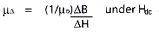
There are many application conditions where DC bias is applied.
The incremental permeability (~t~) is observed when and AC field
is superimposed with a DC field.
|